
MCP live • Circle-ready x402 • EDGAR verified • SPECTRA • Synthetic Basket layer • signed grants • no public API keys
Delta SignalATLAS-7
Filing-backed issuer intelligence for crypto-exposed public companies and DeltaSignal Synthetic Baskets. Daily EDGAR CompanyFacts -> ATLAS-7 evidence rows -> Synthetic Basket pressure layers -> SPECTRA field maps -> REST, MCP, Arazzo, free Natural Language help, signed grant-session access, and x402 workflows.
GatewayWalletBatched, or signed wallet grant sessions. No customer API key handling required.deltasignal_help when you need examples, tool orientation, pricing, grants, Synthetic Basket, or SPECTRA guidance.MCP live • free deltasignal_help live • EDGAR daily background task verified • Synthetic Basket evidence layer documented • /v1/pricing + /v1/contract/fields live • wallet grant-session flow live • standard x402 plus Circle Gateway-ready execution
Hero visual: SEC/XBRL evidence base -> ATLAS-7 intelligence engine -> agent-ready outputs.
DeltaSignal Agent-Native Financial-Evidence Architecture
Follow the complete operating path from SEC EDGAR and CompanyFacts/XBRL collection, through the nightly governed data plane, into bounded MCP evidence delivery and Google Cloud agent specialist orchestration.
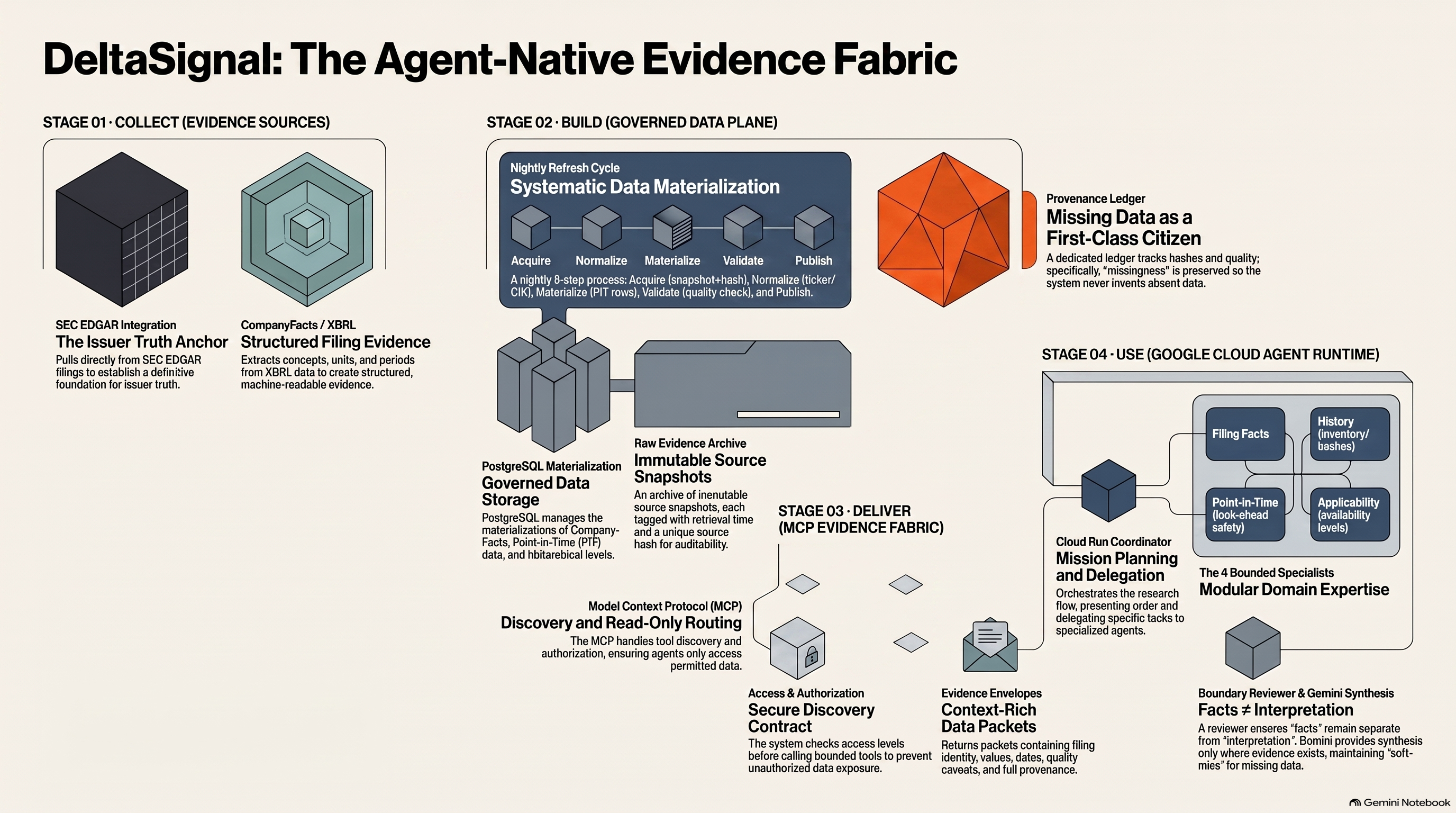
DeltaSignal MCP Evidence Fabric & Integration Lifecycle
Map the four-phase programmatic sequence from free deltasignal_help discovery, through x402 or signed wallet-grant access, into governed atlas7_* semantic tools and inspectable evidence preservation.
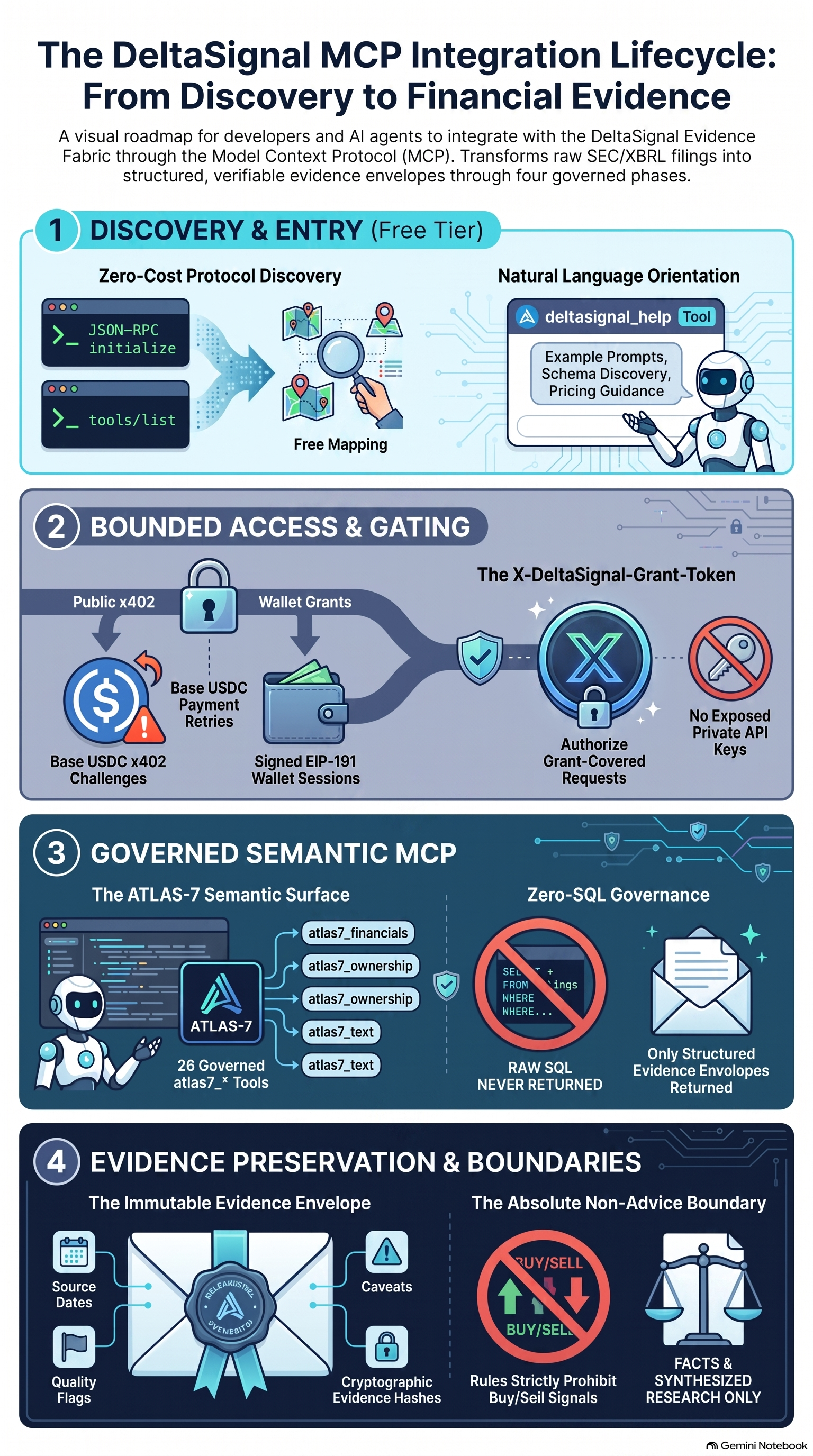
DeltaSignal x402 Direct Settlement & Handshake Protocol
Follow the key-free, six-step settle-and-retry loop: discover a protected route, make the request, receive its HTTP 402 challenge, settle through a compatible rail, retry with proof, and receive the governed evidence envelope and receipt.
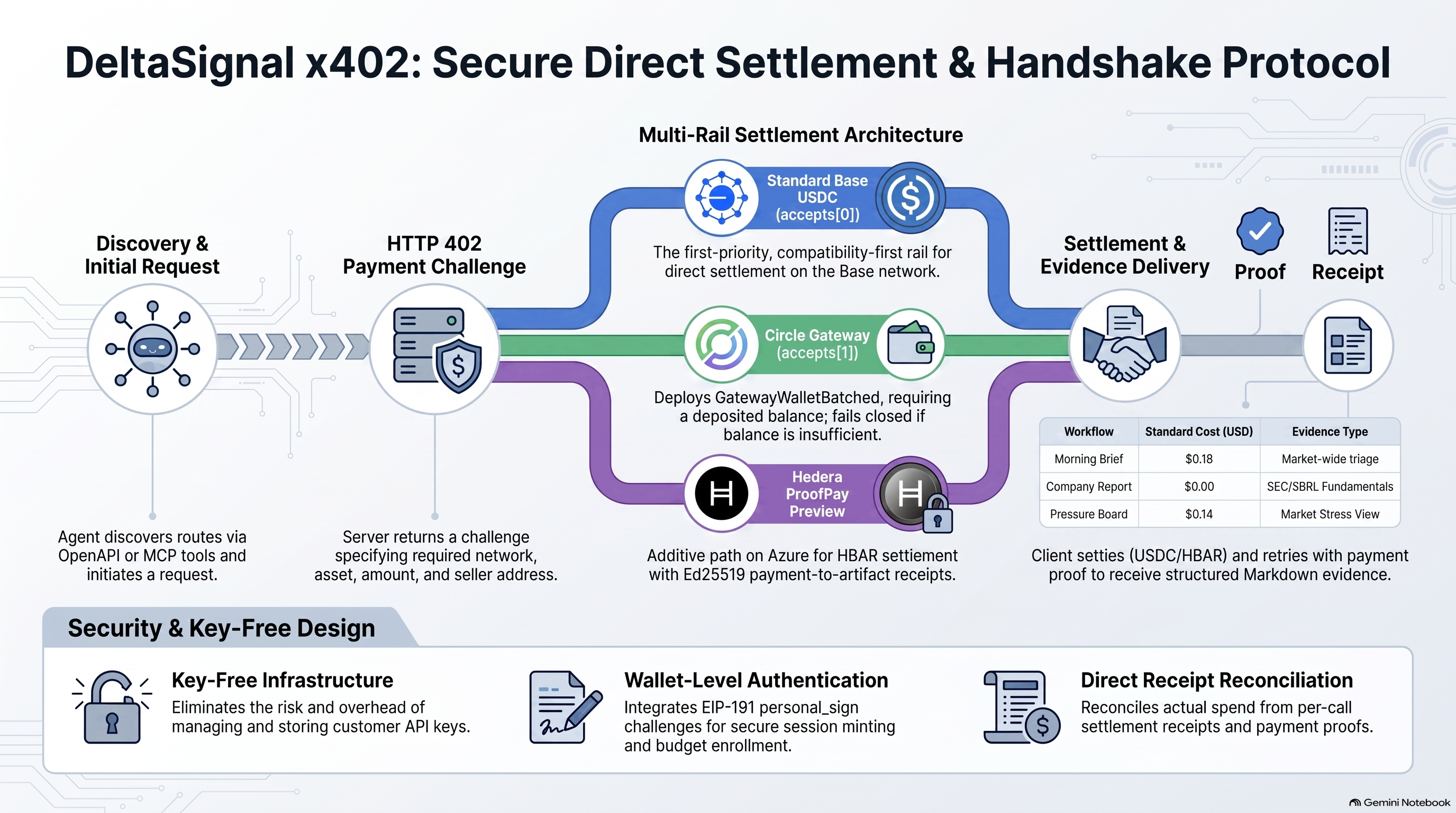
Workflow prices and rail states printed inside Artifact #3 are illustrative snapshot annotations. Always use live pricing, x402 discovery, and the route’s current HTTP 402 response as the authoritative settlement contract.
Start with the live contract
Use this order for a first integration or review pass. It keeps discovery free, avoids customer API keys, and makes every paid or grant-covered call attributable.
Discover
Read /v1/pricing, /v1/contract/fields, OpenAPI, and MCP tools/list before hard-coding route prices, parser fields, or tool names.
Choose access
Use x402 challenge/retry for public paid execution. Enrolled wallets can mint signed grant sessions that resolve to backend database-managed grant budgets.
Run one workflow
Start with Morning Brief, Alpha Sweep, Pressure Board, Company Report, or Quick Ticker Check, then inspect evidence metadata before trusting any prose.
Preserve evidence
Store source dates, quality flags, caveats, evidence hashes, billing state, grant runway fields, and the non-advice boundary with each result.
x402-first public access
Public clients do not need Delta Signal API keys. Use route-level x402 or signed wallet grant sessions, then preserve per-call billing and evidence metadata.
/v1/grant/challenge, sign the message, call /v1/grant/session, then attach X-DeltaSignal-Grant-Token.grant_budget_usd, grant_remaining_usd, and grant_expires_at.Choose a workflow
Composite presets bundle the right evidence routes behind one request, so users do not have to guess endpoint order.
"Give me a Delta Signal morning brief."
Includes readiness, daily changes, risk distribution, top stressed issuers, and alpha opportunities.
"Run a Delta Signal company report for RIOT."
Includes fundamentals, covenant stress, peer ranking, alpha signals, and source metadata.
"Show me the current pressure board."
Includes top stressed issuers, stress tiers, and risk distribution.
"Run an alpha sweep for the current universe."
Includes alpha opportunities, issuer candidates, caveats, and quality flags.
"Quick check MARA before I drill into it."
Includes compact issuer snapshot, stress signal, peer context, and next drilldown options.
"Show the Synthetic AI10 Basket pressure state."
Use for basket pressure, audit caveats, linked-market boundaries, and SPECTRA context.
From filings to usable issuer intelligence
Start with bounded workflows that return structured evidence or readable Markdown, not generic market chatter.
DeltaSignal Four-Level Evidence & Synthetic Basket Framework
Read evidence completeness as a hierarchy: issuer truth first, then public-market behavior, point-in-time basket pressure, and capability-gated derivative dislocation. Unsupported levels remain explicitly missing rather than being completed by an AI model.
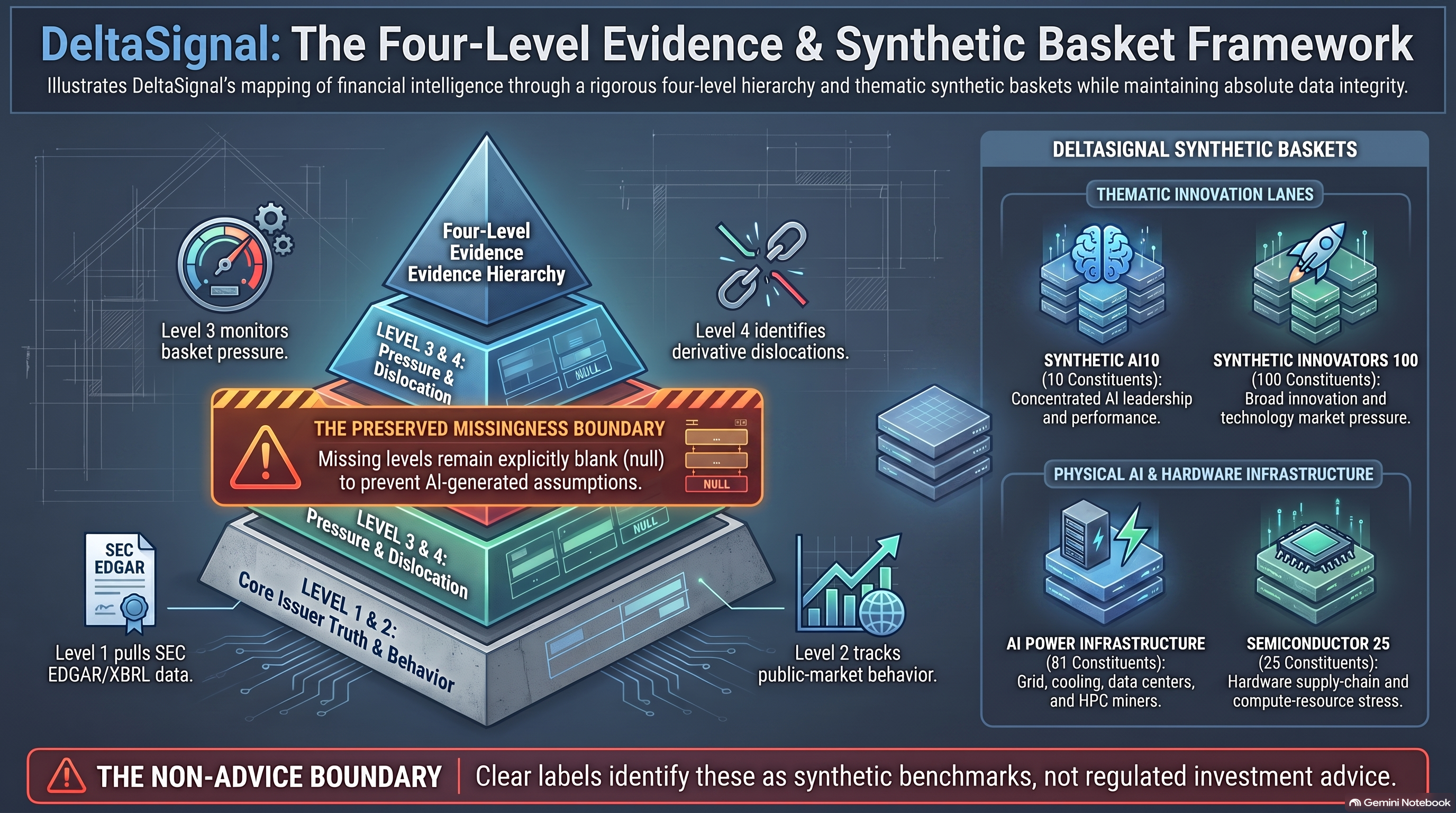
The constituent counts printed inside Artifact #6 are snapshot annotations. Query the live MCP and audit surfaces for current membership, coverage, and source dates. Synthetic baskets are analytical benchmarks—not regulated ETFs, broker signals, or personalized advice.
DeltaSignal Synthetic Basket layer
DeltaSignal Synthetic Baskets are evidence-backed baskets used to explain where issuer truth, public-market behavior, basket pressure, and listed derivative pressure align or diverge. They are not third-party-branded products and they are not personalized investment advice.
July 15 calculation-plane and semantic MCP verification
The public contract is synchronized to the final issuer-wide replay and customer-route audit rather than an older coverage snapshot.
atlas7_* semantic tools.Ask MCP for help first
deltasignal_help is a live, public, no-key, free discovery-tier MCP tool. Use it when a user or agent does not yet know the exact workflow name, input schema, pricing surface, grant behavior, or Synthetic Basket / SPECTRA boundary.
schema_id=deltasignal.help.v1, payment_status=free_discovery, billing_status=not_charged, and x402_required=false.topic=perps explains that Coinbase perp and SPECTRA public reads are over recorded/materialized factor rows, not live exchange fetches, raw order-book ladders, or trade instructions.Ask Synthetic AI10 questions in plain English
Delta Signal MCP now exposes Synthetic AI10 as a discoverable workflow, so users do not need to know the raw tool names before asking useful questions.
help groups to see available workflow groups, then ask help synthetic ai10 for focused Synthetic AI10 prompts, boundaries, and the right next command.What is the Synthetic AI10 pressure state right now? This should route to the compact pressure-state workflow and preserve source dates, caveats, and quality flags.What factors are driving the Synthetic AI10 state? Driver questions should route to audit mode because they require current bucket, previous bucket, deltas, factor history, and provenance.Is Synthetic AI10 in a confirmed ATLAS-7 release event? The answer must use threshold flags and event classification, not only the visible pressure label.Show the Synthetic AI10 audit payload with z-scores, threshold flags, and four-level coverage. This is the right path for technical validation and publication review.Can we safely publish this Synthetic AI10 read? The answer should separate live facts, caveats, unresolved validation, and non-advice boundaries.deltasignal_synthetic_etf_pressure_state for plain current-state questions such as “what is the state?”deltasignal_synthetic_etf_audit for “why,” “what changed,” “is it confirmed,” “do we have z-scores,” “do we have threshold flags,” or “can we publish this?”ca-web-intel-mcp--0000577 returned audit_status=complete, source_date=2026-06-30, observed_bucket_utc=2026-07-01T14:45:00Z, and a 656-row audit export for Synthetic AI10.canonical_event_status=not_confirmed. Treat Synthetic AI10 as pressure-state evidence unless threshold and coverage evidence confirm a canonical ATLAS-7 event.First live probe details
Use this drilldown after the four-step start path when you need the exact help, readiness, billing, and metadata checks for an agent or deterministic client.
Read the agent brief
Start with the plain-text operator brief. It gives the exact read order, first probes, trust order, signed grant-session flow, pricing source of truth, parser contract, and billing assumptions agents are allowed to make.
Ask MCP for help
Call deltasignal_help through MCP when you need examples, available workflow orientation, pricing/grant guidance, or Synthetic Basket / SPECTRA boundaries before a paid route.
Check system readiness
Use readiness through x402, a signed wallet grant session, or a payment proof to confirm the active data slice, service health, and payment state. Public clients do not need Delta Signal API keys. Grant-covered access uses the wallet grant-session flow: GET /v1/grant/challenge, sign the returned message, POST /v1/grant/session, then attach X-DeltaSignal-Grant-Token. The backend maps enrolled wallets to database-managed grant budgets. A plain unauthenticated request may correctly return HTTP 402.
Run a bounded scan
Start with a composite or Natural Language route: Morning Brief, Top-Stressed Brief, Pressure Board, or Alpha Sweep.
Starter prompt: Give me a Delta Signal morning brief.
Inspect evidence metadata
Check source dates, caveats, quality flags, evidence hashes, renderer status, and non-advice disclaimers before using the result.
llms-full.txt first, then changelog-llm.html, then openapi.json, then /v1/pricing, then /v1/contract/fields. That order cuts down drift and prevents stale parser, grant, or pricing assumptions.68 paths, MCP discovery with 81 tools including 26 governed semantic tools, 30 priced routes, 47 parser-contract fields, /v1/grants/status for callers with a resolved grant identity or active grant token, and a signed wallet-grant challenge/session flow./v1/pricing as the quote source and the response billing envelope as Delta Signal billing metadata. Standard Base x402 is the compatibility-first requirement; Circle Gateway is an explicitly selected additive path for Circle-aware clients. Reconcile paid calls from the response settlement receipt plus settlement or payment proof.issuer_evidence_envelope, evidence_sections, spectra_metadata, and publication_audit_block./UNIVERSE with structured invalid_path_scope, billing_behavior=not_charged, and cost_usd=0.ca-web-intel-mcp--0000594 restores standard-first compatibility and honors an explicitly selected Circle requirement. A bounded standard readiness call settled for 0.04 USDC; Circle routing reached the Gateway facilitator and failed closed with insufficient_balance because the test wallet had no available Gateway balance.Built on SEC / XBRL evidence, not token noise
Delta Signal focuses on public companies exposed to crypto markets. It connects filings, fundamentals, financial pressure, peer context, and daily evidence changes into agent-readable intelligence.
Live-loop hardening now documented
Recent integration pressure tests tightened the production contract for grants, pricing, field stability, MCP composites, large payloads, notification delivery, and soft-miss semantics.
GET /v1/grant/challenge, EIP-191 personal_sign, POST /v1/grant/session, then attach X-DeltaSignal-Grant-Token. Raw unsigned wallet headers are not a grant identity. The signed token is the auth artifact; runway and debit semantics come from the live grant-status and billing fields.cost_usd is the customer-visible charged-cost field and should stay 0 for grant, API-key, internal, or discovery bypasses. Public grant and x402 envelopes may also expose quoted_cost_usd, actual_cost_usd, credits_charged, billing_mode, payment_status, billing_status, settlement_receipt, and request_id; reconcile actual paid spend from the per-call receipt plus settlement or payment proof./v1/pricing as the live route-pricing source of truth and /v1/contract/fields for canonical response-field semantics. Company Report is no longer the older $0.30 display price; the corrected standard display price is $0.60 with a route-declared range of $0.45-$0.75./v1/readiness, /v1/daily-changes/latest, /v1/alpha-opportunities, /v1/top-stressed, and /v1/risk-distribution are universe-scoped routes and should remain path-ticker-free.not_found means no evidence is currently available for that endpoint/ticker pair, not a system failure. Clients can suppress known soft misses briefly and re-probe on a cadence because coverage can be backfilled later.These improvements are public integration guidance. Private design-partner names, mailboxes, wallet addresses, grant balances, and support artifacts are intentionally excluded from this page.
Use Delta Signal your way
Start with a bounded workflow, then choose the access path that fits your stack: agent clients, deterministic REST clients, workflow-aware agents, or public x402 routes.
Install MCP connector
REST API
Call Delta Signal directly from your application through x402 challenge/retry or signed wallet grant sessions. Best for backend integrations, dashboards, internal research tools, custom data pipelines, and route-level control without customer API keys.
Open API reference
Deterministic Daily Client
Use Node, Go, .NET, or cron to pull readiness, alpha opportunities, risk distribution, top stressed issuers, and ticker drilldowns. Store evidence metadata, billing metadata, grant runway fields, caveats, and non-advice boundaries per call.
x402-first REST workflow
Composite Workflows
Use one request for common analyst jobs: Morning Brief, Company Report, Pressure Board, Alpha Sweep, and Quick Ticker Check. Best for predictable outputs, lower client complexity, and faster time to value.
Run a composite workflow
Workflow-Aware Agents
Let agents inspect Arazzo scenario plans before execution. Best for tool routers, workflow validation, scenario-specific execution, and reproducible route planning.
View Arazzo workflows
Public x402 Routes
Use payment-aware public access without API keys. Compatible clients discover the service, receive an x402 challenge, settle through Base USDC, and retry with proof. Enrolled wallets can use signed grant sessions instead of settlement while budget remains.
Validate x402 flow
Not sure where to start? Use the composite Morning Brief first through x402 or a signed wallet grant session. Run Morning Brief.
Evidence-preserving outputs
Evidence first. Briefs second. No unsupported invention.
From filings to agent output
Delta Signal is an evidence pipeline first: SEC / XBRL facts flow into ATLAS-7, then out through REST, MCP, Arazzo workflows, x402 public access, and response metadata.
How ATLAS-7 and SPECTRA are generated
ATLAS-7 is the issuer evidence layer. SPECTRA is the field-map layer derived from ATLAS history for inspection, comparison, and agent-safe explanation.
/v1/atlas-history/{ticker}, /v1/point-in-time-history/{ticker}, and /v1/spectra-field-map/{ticker} when a workflow needs the generated history or field-map contract.How agents know and run the workflows
MCP clients discover tools, read the Arazzo scenario plan, use OpenAPI for exact routes, and let Coinbase x402 handle public pay-and-retry execution.
1. Discover
The agent sees the service contract through public metadata and tool discovery.
2. Plan
Arazzo maps user intent to the right scenario pipeline and required inputs.
3. Execute
The client calls one MCP composite or follows the REST sequence step by step.
4. Resolve
Public clients pay when challenged, retry, then receive structured evidence or a compiled brief.
deltasignal_help gives no-key Natural Language orientation. publicMcpX402Handshake proves free public tool discovery and the paid tools/call challenge. internalMcpToolSmoke stays for first-party validation.
Seven Arazzo-defined agent workflows
These are the machine-readable scenarios agents can inspect before choosing a tool or route sequence.
Canonical agent traces
Concrete examples for how an agent moves from intent to bounded workflow, execution, returned evidence, and renderer rules.
Pricing for first workflows
Start with free discovery. Paid public usage is route-level, usage-based, and declared in live route metadata. Public buyers use x402 challenge/retry. Enrolled design-partner wallets can mint signed grant sessions backed by the Delta Signal grant database. Check /v1/pricing first, then confirm with the route-specific x402 challenge when needed.
Delta Signal pricing applies only to Delta Signal-derived evidence workflows and analytical outputs. It does not provide access to, redistribute, or resell any upstream market-data feed.
/v1/pricing, OpenAPI metadata, or the x402 challenge before execution.strategix_delta_brief_pdf_full. Produces one polished, branded, auditable PDF per market day from DeltaSignal evidence./v1/*: standard at accepts[0], with explicit Circle GatewayWalletBatched selection at accepts[1]. Tempo/MPP clients use the matching /mpp/v1/* route family.Live route metadata is the source of truth. Use /v1/pricing for current cost discovery, then reconcile actual x402 spend from settlement or payment proof when the wallet moves. Route prices are for Delta Signal-derived evidence workflows only, not upstream market-data access or redistribution.
Start free. Pay only when a route requires it.
Delta Signal supports free discovery, grant-covered access, and route-level paid access through x402-compatible clients.
GET /v1/grant/challenge -> personal_sign -> POST /v1/grant/session -> attach X-DeltaSignal-Grant-Token. Raw unsigned wallet headers do not unlock grants. The backend resolves the signed wallet to database-managed grant budget/runway records. Use /v1/grants/status with an active grant token or resolved wallet identity to read fields such as grant_budget_usd, grant_remaining_usd, and grant_expires_at./v1/pricing before execution; for example, live Company Report pricing is currently 0.6 cost_usd.route_declared_price. The live contract also reports grant_cache_treatment=fresh_and_cached_charge_same_route_quote for the verified budget-grant path, so fresh and cached covered reads consume the same route quote unless production changes.grant_limit_type=budget_usd, grant_limit_unit=usd, grant_budget_usd, or grant_remaining_usd, treat the grant as a USD budget and size usage from those fields. When it exposes grant_expires_at or grant_expires_in_seconds, treat those as the grant-window fields; the plain challenge/session expires_at fields are short TTLs. If those fields are absent, fall back to best-effort grant coverage plus x402.Use free discovery and one grant-aware or x402-aware test call before running paid workflows. Start with /v1/pricing, /v1/contract/fields, or a bounded Morning Brief.
Hedera ProofPay preview
ProofPay adds a separate Hedera testnet x402 path for deterministic DeltaSignal evidence. It does not replace or silently modify the live Base, Circle, grant, or MPP route families.
proofpay-hedera.kindbeach-299ce8c4.eastus.azurecontainerapps.io. Health, discovery, catalog, quote creation, and OpenAPI are free.hedera:testnet HBAR, then let an approved x402 buyer settle and retry.GET /.well-known/proofpay
Open-source verifierHedera x402 client, receipt verifier, tests, proof bundle, demo, and transcript.github.com/aitrailblazer/proofpay-hedera-x402
Performed testnet settlementCompleted payment from value buyer to seller, with facilitator-paid network fee.0.0.7162784-1784665192-906989595
Creating or reading a quote does not move funds. Do not sign or submit a Hedera payment without explicit user approval, and never expose the buyer private key.
Built for agent-native financial intelligence
Delta Signal combines filing-backed issuer data with modern agent infrastructure: MCP discovery, OpenAPI contracts, Arazzo workflows, composite presets, and x402-compatible public access.
Delta Signal is designed to be useful on the first request and inspectable before deeper integration. Run Morning Brief or open developer docs.
Natural Language brief routes
Readable evidence packages, not unconstrained opinions. Natural Language routes compile returned Delta Signal evidence into validated Markdown briefs.
Granular tools for exact control
Use these after you know which workflow, issuer, or evidence layer you want to inspect.
TripCode research continuity
TripCode / River subscriber research is visible in public MCP discovery, but execution is x402/grant-gated and evidence-dependent. Subscribers can paste a TripCode into Codex or Claude Code only when the live tool call can resolve the required River / issuer index blobs.
Build a GET route
Natural Language GET routes use query parameters, not JSON request bodies.
Install in your agent client
Install details come after the first-test and pricing model so you know which path you are enabling.
Open Glama connector
REST Quickstart Path
Use OpenAPI if you want direct HTTP route control instead of MCP.
Open API reference
Quickstart
Route-level integration, response metadata, fallback modes, and SDK wiring.
./quickstart.md
Reference surfaces
Inspect the exact contracts when you need implementation detail: schemas, pricing, parser fields, workflows, MCP endpoint, x402 handshake, and agent-readable guidance.
https://api.aitrailblazer.net/openapi.json
Live Pricing
Authoritative route cost discovery for public clients, including current cost_usd values and grant-session metadata.
https://api.aitrailblazer.net/v1/pricing
Field Contract
Parser-stable field discovery for response paths you should preserve or key on before you wire an agent parser.
https://api.aitrailblazer.net/v1/contract/fields
Changelog
Public changelog for atomic Company Report routes, OpenAPI discovery, ATLAS-7 history, audit status, SPECTRA, x402, and MCP workflow upgrades.
./changelog.html
LLM Changelog
LLM-optimized changelog with instructions, tripcodes, breadcrumb bread, and an ordered tracking river.
./changelog-llm.html
Quickstart
Route-level integration, response metadata, fallback modes, and SDK wiring.
./quickstart.md
LLM Instructions
Agent-facing rules for evidence boundaries, renderer metadata, and non-advice constraints.
./llms.txt
Full Agent Brief
Canonical operator contract for IDE agents: exact read order, first probes, grant sizing rules, billing and reconciliation rules, parser guidance, MCP call shape, and production boundaries.
./llms-full.txt
Claude Code Guide
Project-level Claude Code instructions for MCP install, readiness, composite-first tool use, x402 payment boundaries, refusal rules, and HUT TripCode caveats.
./CLAUDE.md
Arazzo YAML
Machine-readable workflow plans for agents.
./arazzo/deltasignal-arazzo.yaml
Arazzo JSON
JSON mirror of the workflow plan for clients that prefer JSON.
./arazzo/deltasignal-arazzo.json
x402 Handshake
Public payment challenge and retry workflow.
./arazzo/publicMcpX402Handshake.arazzo.yaml
Circle Agent Marketplace review path
Review Delta Signal as an x402-compatible seller service for AI agents: discover the public contract, verify standard Base x402 at accepts[0] and Circle Gateway at accepts[1], retry through the selected capability or a grant token, and preserve returned evidence provenance.
Seller service lifecycle
Start with free discovery, then verify the 402 challenge, Circle-aware payment option, paid retry, and per-call receipt metadata before listing.
Circle-ready payment proof
Pass requires a public x402 resource, seller payTo, amount, network, asset, standard Base x402 compatibility, and an explicitly selectable Circle Gateway option exposed as GatewayWalletBatched.
https://api.aitrailblazer.net/openapi.json
No-Payment Probe
Use an x402-capable discovery client to inspect pricing and payment requirements before paying or attaching a grant token.
GET https://api.aitrailblazer.net/v1/readiness
Circle Seller Reference
Circle Gateway nanopayments seller flow for x402-compatible APIs that accept gasless USDC payments.
developers.circle.com/gateway/nanopayments/quickstarts/seller.md
Executable Circle-aware Buyer
Installable Node.js example with dry-run selection, Gateway-domain signing, explicit payment, and sanitized receipt reconciliation.
examples/circle-aware-buyer
GatewayWalletBatched for explicit Circle-aware selection.insufficient_balance; that closed failure is not a charge.Verified developer surfaces
Technical buyers can validate the public MCP endpoint, Open API contract, and x402 payment rail before paid use.
Public MCP + Open API
Agents can inspect the hosted Streamable HTTP MCP endpoint and public route contract, then use signed grant-session access or x402 routes under /v1/* for execution.
x402 / Circle Settlement
When free or grant-covered calls are unavailable, the route returns a 402 challenge with payment metadata. Standard Base x402 remains first for compatibility; Circle Gateway is an explicit additive path for clients that support GatewayWalletBatched and have available Gateway balance.
glama.ai/mcp/connectors/net.aitrailblazer.api/delta-signal-atlas-7
Remote MCP Endpoint
Connect MCP-compatible agents directly to the hosted Delta Signal ATLAS-7 tool surface.
https://api.aitrailblazer.net/mcp
Open API Spec
Inspect the REST, MCP JSON-RPC, composite-tool, daily-monitoring, and audit-status discovery metadata used by validators.
https://api.aitrailblazer.net/openapi.json
Arazzo Workflow Spec
Use scenario pipelines for public MCP x402 handshake, market scans, issuer diligence, daily evidence, and MCP composites.
./arazzo/deltasignal-arazzo.yaml
Natural Briefs Quickstart
Route examples, response schema, renderer modes, validation model, caching rules, and SDK snippets.
./quickstart.md
Agent Rules
LLM-readable guidance for Delta Signal Natural Language Briefs, evidence boundaries, and non-advice policy.
./llms.txt
Live versus planned route status
Know what is callable now. Treat route status as operational metadata and confirm the current surface in OpenAPI, Quickstart, or route metadata before wiring production flows.
Claude Code and agent setup
Use the project guide before running Delta Signal from Claude Code, Codex, or any MCP-compatible coding agent. It keeps the first run bounded and evidence-preserving.
Open CLAUDE.md
The Claude Code guide explains MCP install commands, readiness checks, composite-first tool use, x402 boundaries, TripCode caveats, and refusal rules.
Add the MCP endpoint
Install Coinbase payments support where needed, then add https://api.aitrailblazer.net/mcp as the Delta Signal ATLAS-7 MCP server.
Ask help, discover, then execute
Start with MCP deltasignal_help, then tools/list, check readiness, run one bounded composite, then inspect source dates, caveats, quality flags, payment metadata, and non-advice boundaries.
Evidence first
Agents may summarize returned evidence, but they must not invent missing facts, override caveats, turn screens into recommendations, or claim unavailable drilldowns were fetched.
Operator and audit workflows
Operational visibility helps confirm whether the ATLAS-7 pipeline is healthy before users depend on live evidence outputs.
Developer copy block: first call
Copy, run, inspect. Start with readiness, then run a bounded workflow through your selected access path.
Build with SEC-grounded issuer intelligence
Delta Signal ATLAS-7 turns SEC / XBRL filings for crypto-exposed public companies into structured evidence, bounded workflows, and agent-ready outputs.
/v1/pricing, /v1/contract/fields, and readiness through the correct grant or x402 path, then inspect OpenAPI and Arazzo for exact schemas or workflow automation.Start with readiness through x402 or a signed wallet grant session. Run one bounded brief. Trust the evidence metadata before the narrative.